Getting Fit Again
Humbled on the Racquetball Court
In April ’24, a friend’s father invited a few of us to his gym to play racquetball. He also let us invade his house for a few days for a solar eclipse – he’s a real nice guy. Anyway, the main point is: this man is around 70 years old, and he crushed me. Actually, I’m pretty sure I was the youngest person on the court that day, and everyone crushed me. It wasn’t just a lack of racquetball skill, it was an inability to move quickly without hurting myself! I limped out of that gym, and my back was sore for the next two weeks.
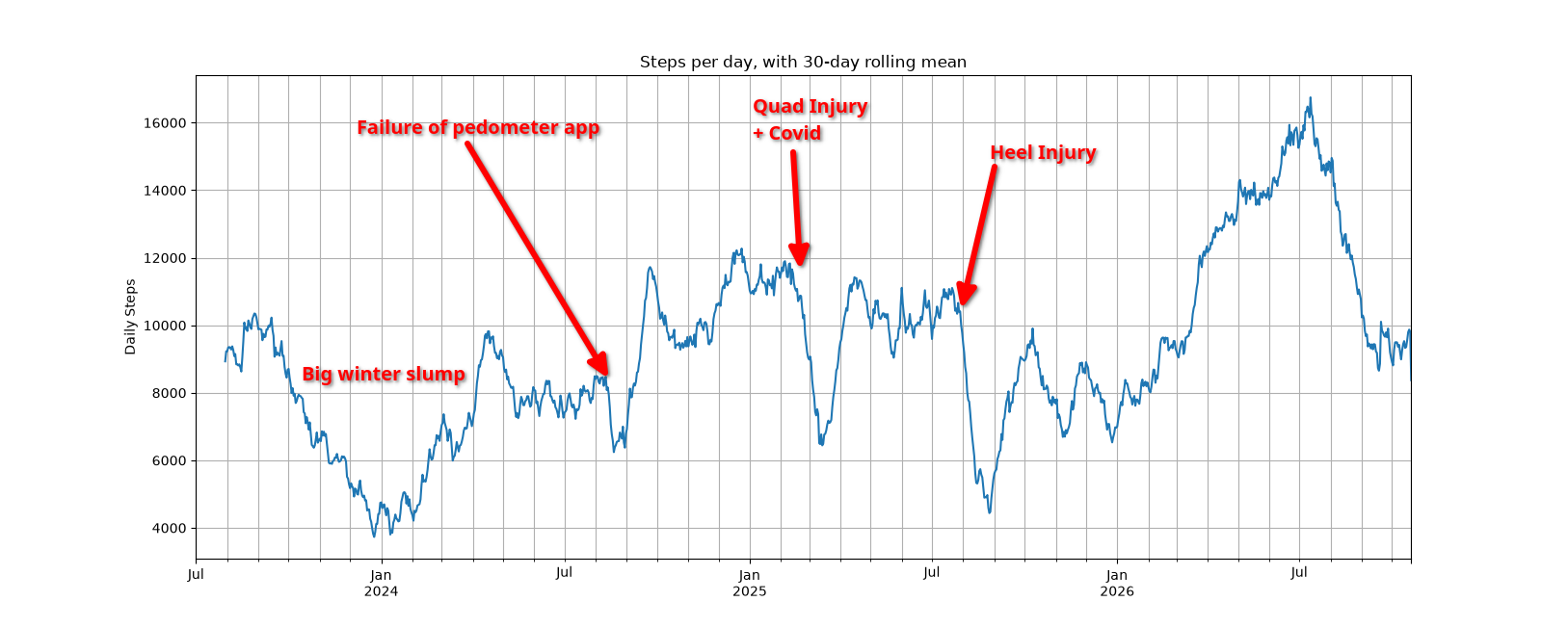
I sometimes cite this story as the moment I realized I needed to do something about my steadily declining fitness, but that’s a bit simplistic. Actually I had installed a pedometer on my phone and made a point to walk more since August ’23 – 8 months earlier! I had even started running very occasionally by then. Frankly, it wasn’t like I needed the racquetball experience to see how much my fitness had deteriorated – a mirror, a scale, or attempting to play soccer with some kids all made that clear enough. But that day certainly emphasized it.
I’ve never been a workout person. I never belonged to a gym. I participated in the first race of my adult life just a couple years ago. I managed to stay in basically OK shape, back when I lived in California, just by being out all the time. I went on bike rides around town regularly, and I rode a mountain bike around the trails in the hills occasionally. I went on a lot of hard hikes. That kind of thing.
Then I moved to Seattle, where I found myself working more, with more stress, and moving away from the group of adventurous friends that I did all of those activities with meant I didn’t do nearly as many of them. So over 8 years or so, I slowly shed muscle and accrued fat. Some clothes stopped fitting; I no longer felt confident to tackle big hikes; I felt bad about it. Something had to be done.
Getting into running
My philosophy on running until recent was simple: it’s the worst. Maybe I picked this attitude up from my mom: she never misses an opportunity to point out how she never sees a runner who looks happy. But somehow, despite my past reservations, I decided it was time to give running a shot. Iw was partly the influence of people around me, and partly the ease of just being able to go out the door anywhere and run without buying any gear. Anyway, enough factors converged that I did run, and then I did it repeatedly, and increasingly, until a funny thing happened: I found that sometimes I actually wanted to run.
I also got faster and stronger. The first year was surprisingly rewarding. It turns out that if you’re in particularly bad shape like I was, it is easy to improve! When I first started, I couldn’t jog a full mile without walking, so the first time I was able to complete my usual 3 mile route running the whole way was huge! My running playlist included the song “Fake Plastic Trees” by Radiohead, and whenever I hit that last verse – you probably know it, it goes “She looks like the real thing…I could blow through the ceiling…etc” – I would break into a sprint. It’s about a minute long, and at first, I couldn’t maintain the sprint through the whole minute. Then I could do the whole minute, but I’d be bent over gasping for breath after it was over. Then one day, I just…sprinted through the whole verse and then fell back into my normal pace after it ended.
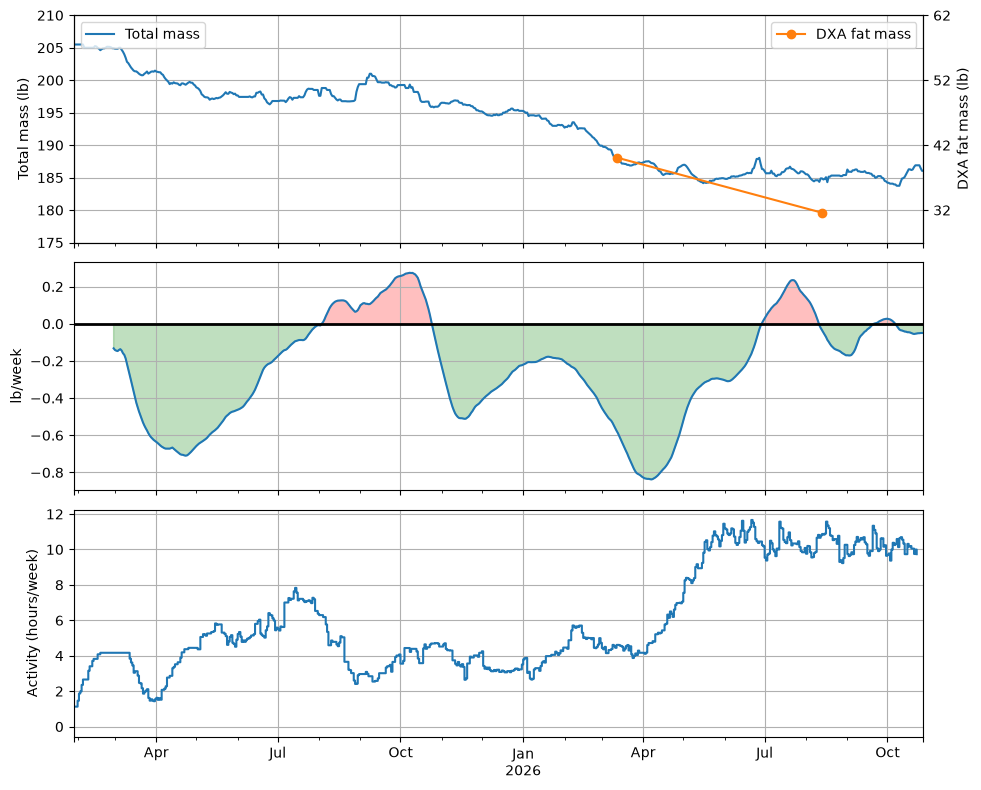
This constant stream of improvements was very motivating. As I started to see my weight go steadily down, that was motivating too.
My First Foot Race
In July 2025, I ran my first race – a 5k. I had signed up for an earlier race in the spring, but had to skip it due to an injury. By this point, I had been running regularly for over a year.
I guess I would have to describe myself as fairly competitive, but I didn’t fully appreciate the effect that running around a lot of people would have on me. When I went into that race, my fastest 5k time was around 26:37. For me, this was great, but it’s not exactly a fast time. I was thinking if I could just finish under 26:00 on race day, I’d be really happy. When the race started, there was always someone a little bit faster than me ahead to chase, and I just kept trying to keep up with them. Towards the end of the race, I got passed by an 8-yr old kid, and I became wholly committed to keeping up with that kid. He pulled me to the finish line, and I finished in 24:20, substantially faster than I thought possible.
I learned something about myself that day: although I enjoy running solo, the pressure of a timed race with other people pushes me beyond anywhere I will ever push myself alone.
Running Does Hurt, Actually
Part of my pre-existing bias against running turned out to be accurate though: it was rough on my body. I kept hurting myself: a pulled quad, a stress fracture in my heel, and all kinds of intermittent pain in my feet and knees. There may well be things I can do to run more resiliently! Many people have told me that I need to be strength training, and I’ve recently started doing that with more seriousness. Everyone also seems to agree that I should be doing the vast majority of my running at an easy paces, but I have a bad tendency to run harder than I intended a lot of the time.
I hope that these things will help, and I intend to keep running, but for now at least I don’t have any big mileage ambitions. I am however spending a lot more time on the bike, and have discovered bike races are actually more fun. So while running got me started on this journey, for the moment, the bike is helping me continue it.
Cycling Wins Again
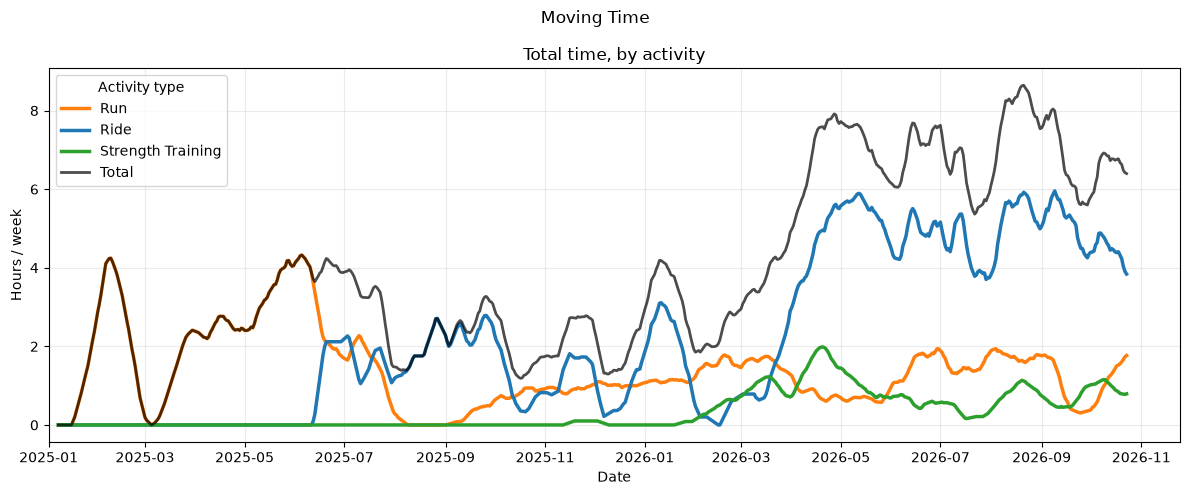
Historically, I always thought of cycling as running without the impact. Now I’m back to that, but with a greater appreciation of the merits of running. The plot above kind of says it all – cycling opened up the ability to do many more hours of training. The limiting factor for running has always been the amount of running my body can tolerate – with cycling, I’ve yet to hit any such limit. I read The Mid-life Cyclist this year, and its author supports an operating theory that makes a lot of sense to me and which I too have adopted:
- Cycling provides excellent cardio with minimal impact, which is great for your joints and can remain accessible well into old age. Do a lot of it.
- Also do resistance training to build muscle mass and fight off the inevitable loss of muscle fibers that happens as you age.
- Also run. There IS benefit to the impact of running – e.g. in maintaining bone density – that you just don’t get out of cycling. Just as importantly, I still enjoy running, and want to get faster. So I’m going to keep running every week. I’m not training for any marathons though.
Another reason to lean into bikes: Last fall I discovered the Seattle cyclocross racing scene. This fall I’ve been racing almost every weekend, and having more fun than I’ve ever had at a trail run.
Progress Tracking and Training Structure
I’ve been pretty lax about structure in training. I don’t doubt that people who have spent a lot of time studying athletic training have a better idea how to optimize, but still I feel like where I’m at, I’m just not that concerned about achieving peak efficiency. The bigger question is, “will I do it?” and if I do what I feel like then I think I’ll do more of it. I try to do some intense work, more easy work, and to get out as much as I can until my body tells me to take it easy by hurting too much. I’ve been pretty happy with the ad-hoc system, but I may experiment with a bit more structure for training going into next year.
Unstructured as I may be, my brain does love a good metric, and making a graph go up can be a strong motivator, and also a regulator (“don’t go up too fast”). But what to track, especially when mixing sports? I bounced around among a few things. I started using Strava and the Elevate for Strava plugin to track fitness/freshness numbers. Strava now has a version of this, but I find elevate a lot more intuitive. This metric basically computes a heart-rate or pace based stress score for each run, and then applies two different exponential average filters to the score. This allows you to compare your recent effort (the short time running average) to your baseline (the long running average), and if you’re building then you’re goal is basically just to keep the short term average a little above the long term. A nice benefit of this method is that it sort of allows you to account for mixed sports. Heart rate reserve seems to be about the best proxy for workout intensity I have available.
There’s a lot of noise out there about heart rate zones. Fitness pundits seem a lot like diet pundits – there are a lot of them and they are often, at least in my estimation, epistemically questionable. People can’t even seem to decide on the formula used to determine zones, using %HRmax, HRR, etc. I foolishly assumed that things shown in various apps like strava might actually mean something at first, but I’ve come to the conclusion that its mostly their to look useful. One of the best resources I’ve found for is runningwritings.com – that article does a great job of explaining where the idea of HR zones comes from.
After my bad heel injury, I decided to set an explicit running mileage goal. I started at a puny 2.5 miles per week, and set the target to increase 5% every week through May when my first trail race was scheduled. To track this for myself, I wrote a little python script to generate a plot that showed target mileage, and a running exponential average of my mileage based on data from the Strava API. I put that script on a web server, with a cron job to update the page periodically. Strava has goals, but it doesn’t have any good way to program the 5% ramp rate, and more importantly, it’s goals are weekly. I really don’t like weekly goals, because it creates artificial discontinuities. There’s nothing special about midnight on Sunday, and it hardly matters whether I run on Sunday or Monday. I think setting targets based on a moving average makes a lot more sense.
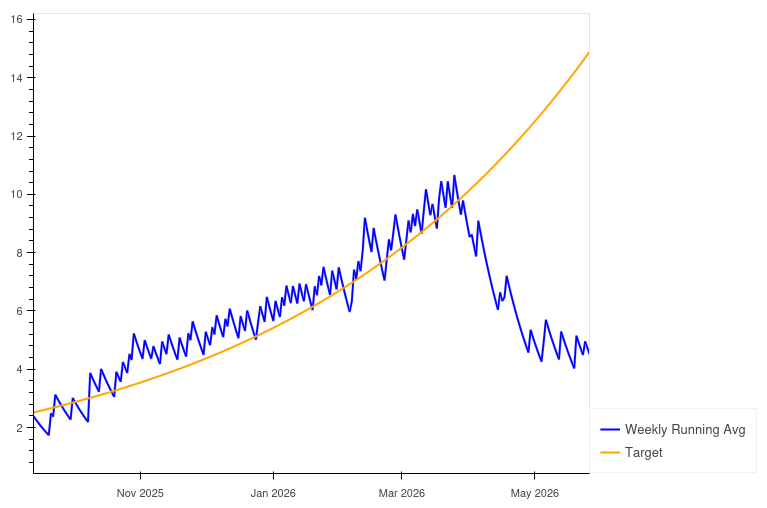
You can see pretty easily in that plot where I hurt myself again. Ramping up the mileage slowly was not enough, it seems.
DXA Scans
I’ve done a couple of DXA scans to determine body composition. These are quick and easy. There’s a van that parks outside gyms and such locally, and it costs $60, although they are regularly having sales for $40. Mass is clearly not everything, and it has been interesting to be able to measure both lean and fat mass changes independently. I think I will keep doing these every few months for a while, and I wish I had started them sooner.
Conclusion
As I was editing this, I had to ask myself why I’m writing it. I’m a neophyte at everything discussed, so I don’t have any great depth of experience to share. I don’t want to just write it to brag. But the truth is I’m pretty happy about it! I’m happy about feeling fitter and healthier, and more confident about being able to do physically demanding things. I feel like I’ve discovered something new in life! It’s new to me anyway, even though of course many people have been doing this for my entire life! It’s interesting too to collect the data and look back over a few years of progress, and writing it down helps me do that.
If you’re like me and haven’t made a point of deliberate physical training, I would definitely recommend finding some form that seems appealing and giving it a try. It’s mentally and physically rewarding, and I expect will help fend off the inevitable effects of aging. I personally hope to one day be 70 years old and humbling people three decades younger than me on a racquetball court – or a cyclocross course, whatever.